A Good Craftswoman Doesn't Blame Her Tools. So What Happens When the Tool Learned From Us?
Most of what I write here is about digital marketing, search and web builds. This one starts somewhere else, with a collection of brass boxes I made in 2009, because the two ends of my working life keep meeting in the middle and last week they met again.
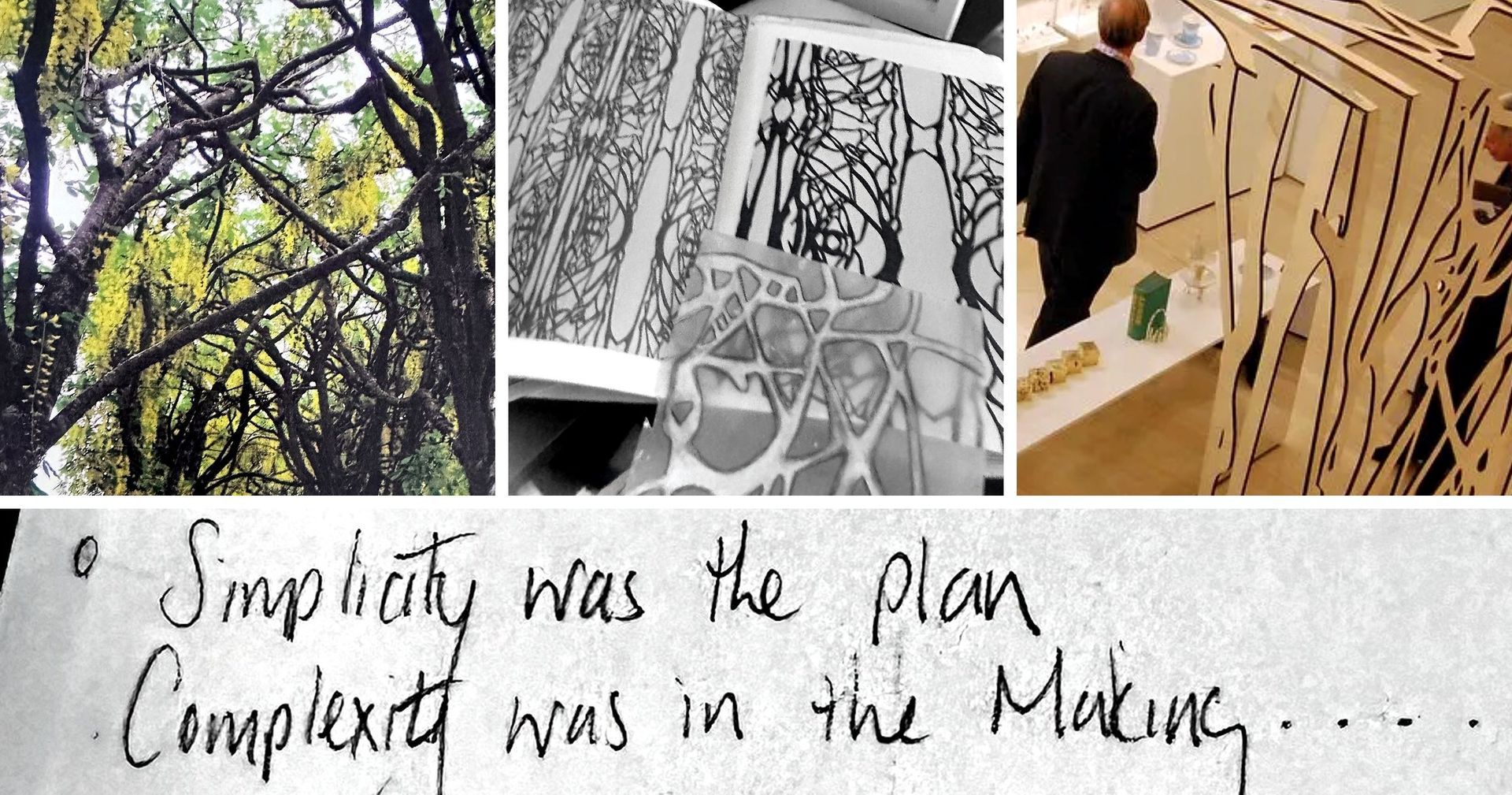
In 2010 I showed Surfacing Complexity, Surfacing Simplicity at Collect. It started in a sketchbook with laburnum trees I photographed at Cawdor Castle and Gardens in April 2009, which I drew until the branches became a single pattern. That one pattern then ran through the whole collection: prints, lights, jewellery components, wooden cubes, and boxes in brass, laser cut, hand formed and gold plated.
It was the last complete collection I've shown in the UK. Not the last work, though. I moved to the US in 2013, and the practice carried on in a different shape: commissions, pop-up design events, and commercial design work, first inside companies and agencies and later through my own digital business. That's a familiar enough story for anyone who makes things for a living.
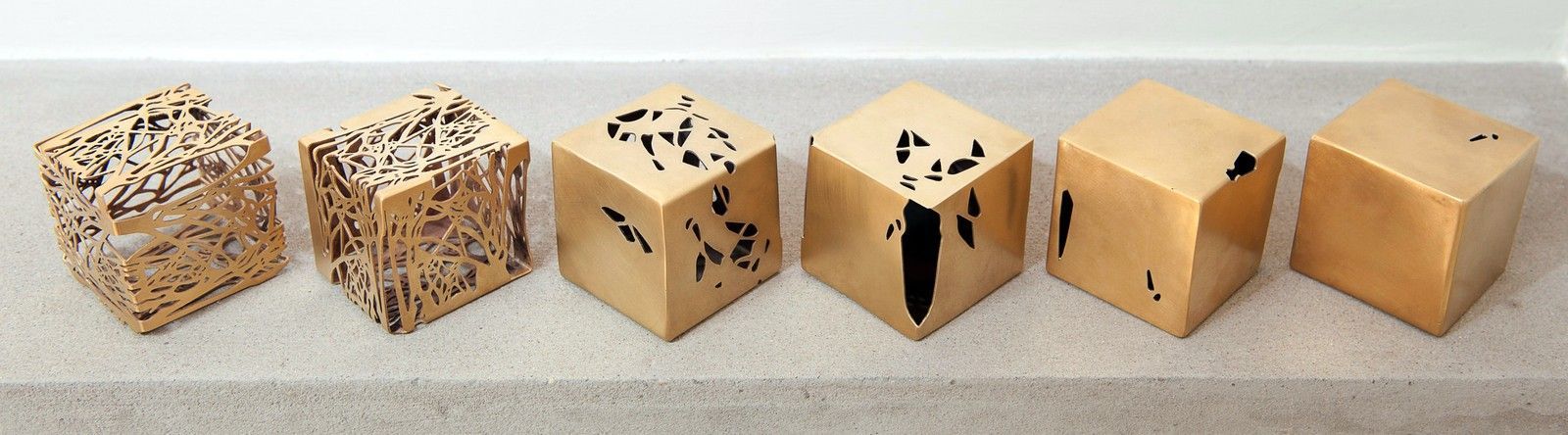
The question behind the collection was whether we were building our own boxes, even our own prisons, in response to technology and the rise of mass social media. The cubes run between open lattice, where the pattern is almost all branch, and a closed, solid form with barely a mark on it. Read one way, it's a traverse from the city and its technology out into nature, from a solid surface to something freer. Read the other way, it's the box closing in. The gold plating felt poignant at the time, because a gilded box is still a box.
My notes from then put it better than I could now:
Simplicity was the plan. Complexity was in the Making.
At points the contents of the plan are obscured. It's the plan, the route, that holds the most important meanings.
It might look ironic that I now spend most of my working week inside the world that collection was questioning. It isn't, really. I've never been against the tools. At university we trained in Rhino 3D and web alongside the bench, and I was drawn to new manufacturing methods as much as traditional ones. The brass boxes themselves were laser cut and then hand formed. The question was never whether to use technology. It was what we lose if the tacit, haptic knowledge that lives in the hands drops out of the process, and whether we notice the box going up around us while it does.
That question was on my mind last Thursday at the Edinburgh Futures Institute, at a panel called The Future of Research in an Age of AI. It set out to explore how AI changes what researchers do, how research is carried out, and what universities contribute to society. My work has always sat where making and digital meet, from the bench to helping businesses work out what AI actually changes for them. I came home on the bus with a page of notes, and these are the threads I keep pulling on.
Incentive and Intent
The note I keep coming back to is that incentive and intent are two very human conditions. If AI is trained on what humans have written, made and decided, it doesn't arrive neutral. It carries the incentives and intentions built into that material, and into the choices of the people who selected it, weighted it and decided what it's for.
Incentives also shape what gets said out loud. Some industry webinars have started posing that question directly: how freely can people speak about where AI is heading when their livelihood depends on the companies building it? The pattern will be familiar to anyone who has worked in an industry with a lot of money riding on one direction of travel. The people closest to a technology are often the least free to question it in public.
So when we ask whether AI can be trusted, the more useful question is whose incentives it is carrying, and whose intent it is serving.
Who Asks the Hard Questions
The panel was clear that it's the job of universities to ask the difficult questions and put them to government. That means going beyond "what can this do?" to "what does it cost, and who pays?"
The cost isn't only financial. One panellist spoke about AI and automation, and the human cost is where that lands: in jobs, in skills, and in the kinds of work that stop being taught or valued. There is a cost to industry too. And as the panellist speaking from a public health perspective pointed out, it's always governments and the state that are left to pick up the pieces. States are also moving at very different speeds, some fast and some slowly, and neither is automatically the safer choice.
Another question I noted was whether taxing the major tech companies might have slowed the "progress" of the technology. It's a question rather than a settled answer, but the pace of AI is the result of decisions, not a law of nature. This month some of the people making those decisions have said so themselves, with leaders at the major AI companies calling for a global slowdown. What's on the table leans heavily towards the industry regulating itself, and a growing number of policy experts argue that isn't enough.
A call to slow down deserves to be taken seriously. It also deserves the question of who it serves, and who decides what "slower" means. That's exactly the kind of question universities are there to put to government.
Agency and Collaboration
Since February last year I've been taking part in Applied Arts Scotland's Digital Play project, a small group of makers exploring haptic 3D modelling in Anarkik3D Design. You shape digital forms through a device that pushes back, so the hand stays in the making. The briefs were loose on purpose: Boolean, Ugly, Texture. Permission to play, which is the first thing squeezed out when your time defaults to client work.
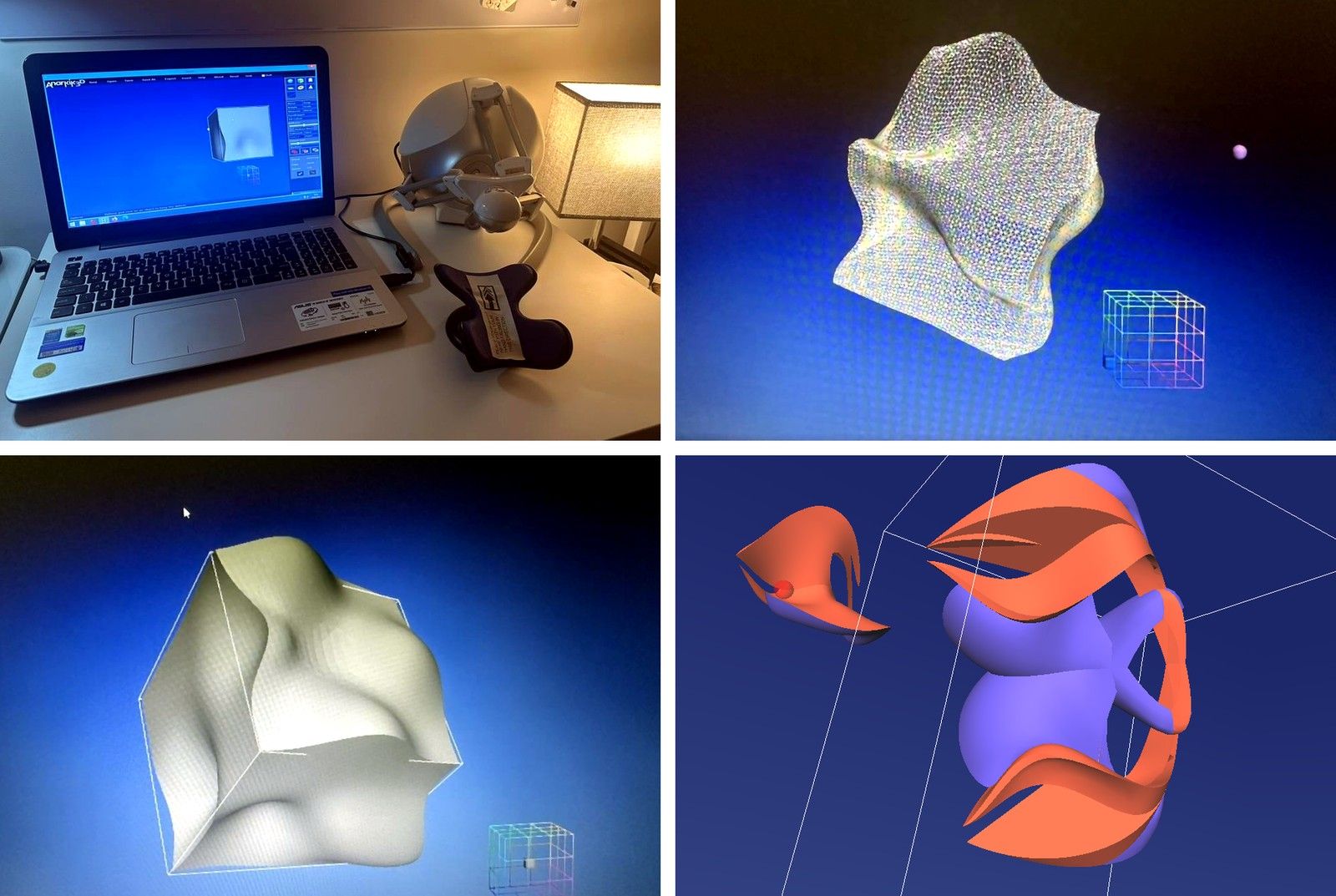
The software is worth a word of its own. Anarkik3D was founded by Ann Marie Shillito, a jeweller who literally wrote the book on digital craft for applied artists. A tool built by someone who has stood at a bench behaves differently from one built by someone who hasn't, and you can feel it in the first ten minutes.
Working this way makes one question hard to avoid: who is doing the thinking? With a good tool, agency stays with the maker. You can tell where the tool is helping and where it's quietly deciding for you, and working with a tool only counts as collaboration if both of those are visible. It's the same question the boxes were asking: are you shaping the tool, or is it shaping you?
For me, that's the question underneath all of this. What happens to tacit, haptic knowledge as AI shapes design, and who holds agency in the process? It's also the seam I wrote about in Digital Collaboration: Why the Best Work Happens at the Seam Between Craft and Code.
A Good Craftswoman Doesn't Blame Her Tools
It's an old saying, usually used to tell someone to stop making excuses, and usually it says craftsman. But it rests on assumptions: that the maker chose the tool, understands how it works, and knows its limits well enough to take responsibility for the result.
With AI, those assumptions don't hold by default. Plenty of people are using tools they didn't choose, trained on material they can't see, shaped by incentives nobody explained to them. The responsibility doesn't disappear, but it has to be earned through understanding. That kind of understanding has always been built with the hands as much as the head.
That's why the recent news from the University of Edinburgh landed badly. It is closing around 90 programmes across its College of Arts, Humanities and Social Sciences to new admissions, including five at Edinburgh College of Art. Whatever the financial pressures, physical making and hands-on tuition are being pulled further from the next generation, just as AI reshapes how design gets done. If we want people who can use these tools well and stand behind what they make with them, we need people who build tacit, haptic knowledge alongside the digital tools, not instead of it.
What This Means for Businesses
None of this is abstract for the businesses I work with. The same questions turn up every week in smaller form. Which tool, trained on what, serving whose incentives? And who in the business understands the output well enough to put their name to it?
That's why I keep returning to process before prompt, and why testing tools properly matters more than picking the one everyone is talking about.
It's the route that holds the meaning, not the surface. I wrote that in a sketchbook in 2009 and it's a fair description of what good AI adoption looks like too. If you're working through what AI changes for your business and want a practitioner's view rather than a sales pitch, talk to us about digital consultancy.
Digital Articles + Stories